Friday, 12 December 2014

Thoughts on Fund-Raising for ME Charities

Recently there has been much talk on ME groups about ME patients doing physically challenging fund-raisers.  I expressed my opinion on Face Book and thought I'd copy it here:

"Personally I am as uncomfortable with anyone who has ME (or previously had ME) doing a physical challenge to raise funds for an ME charity as I would be if:

- a type one diabetic decided to do a cupcake eating marathon
- a lung cancer sufferer decided to do a sponsored chain smoking event
- a coeliac was sponsored for eating a normal loaf of bread
- an epileptic was sponsored to spend an hour in a room with strobe lighting
etc. etc.

It is the fact the sponsored event is for DOING the very thing that causes HARM to those individuals is where the problem lies. 

The fact that:
- the diabetic might be going to shoot insulin for his sugar marathon or,
- the lung cancer sufferer might be using ultra filtered herbal cigarettes or,
- the coeliac might be going to have his stomach pumped or,
- the epileptic might have a crash team on standby....
..... is totally irrelevant to the media who will use the shock value of the situation.

Considering that the media already likes to cast a slur on the ME population, preferring to highlight only our fatigue, I really feel very strongly that an ME charity should not help this media-spun "fatigue-only (but you can overcome it if you just try)" perception in ANY way!

And most especially not, by suggesting that physical challenges are likely to be harmless to an ME sufferer.


Sorry for being blunt, but that is how I see it.

The way the ££ is raised is important.

PS  I have NO problem with healthies doing physical challenges.
My own family have run a marathon relay, and done a big cycling event to raise funds, and I (the ME sufferer in the family) was not physically challenged during the events.

Suggestions for ME patients:
- A sponsored month off sugar/milk/bread or whatever individual decides would be a challenge for them.
- Sponsored silence
- Sponsored haircut, hair dying or beard shaving/growing
- Sponsored month with no TV or no films or no Soaps
- Sponsored sleepathon or Pyjama days.
- I loved the Blue Tea Party Idea.. helped by others who are well of course

ME patients can also do a load of awareness raising for the healthy peeps who are doing those marathon events."

Do others also feel this way?

Wednesday, 8 October 2014

Cards for Karina


Recently Michael Evison added a "Cards for Karina" appeal to various groups on Facebook.

I fully support his campaign and will be sending my Card for Karina to Ketty Hansen, Karina's mother.  I would like to encourage as many others as possible to do the same.

This statement is from Bente Stenfalk, a Danish ME Advocate who is in touch with Karina's parents:

AN OFFICIAL STATEMENT: Re Karina Hansen:
It is Karina Hansen's birthday is on November 7th.
Karina has been moved from the hospital in Hammel and is now being held here: Tagdækkervej 10, 8450 Hammel.
Karina has been placed in a home for people with brain-damage! No one knows why… Karina's parents are still not allowed to visit her and kept kept out of her ‘case’… and Karina Hansen still has a guard, who is not very talkative or helpful.
We all dearly hope that Karina Hansen has not been injured by the treatment she has got in the Hammel Neurocenter.
I Hope you will all send Karina Hansen a card for her birthday. 
A lot of cards will show that she is NOT forgotten, and that she will never be forgotten.
You can either send your card to:
Karina [and Ketty*] Hansen, Tagdækkervej 10, 8450 Hammel, Denmark
or to her parents:
Per og Ketty Hansen, Kløvermarken 8, 7500 Holstebro, Denmark.
Karina's parents will try to give all the cards they get from you, to Karina on the day of her birthday.
So please show Karina Hansen and her parents that they are not forgotten by sending cards for Karina on her birthday on the 7th of November.
Also just as importantly, show the psychiatrists and the politicians that we still remember what they did to a severely ill young ME woman, and that we are a LOT of people, who hope something like this will never ever happen again.
It was illegal and wrong, and the psychiatrists hurt a young woman and her parents unforgivably.
Bente Stenfalk
Michael added his own commentary to this statement.  He says:

My own opinion is that anyone opting to send their cards to the new hospital unit will be wasting their money and energy, as VERY FEW informed people believe that they will give the cards to Karina.
My view is that you are better sending your cards to Karina's parents address in good time for her birthday. That way, Karina's parents will see the out pouring of worldwide support for Karina from PWME on her birthday and every day that Fink is holding Karina against hers and her parents will.
Karina's mother is very touched by your generosity towards Karina and looks forward to seeing the many cards from around the ME world.
Thank you all
Michael
For those in the UK. IiME have many cards that they will write and post for you, if you have difficulty dealing with it yourselves in exchange for a donation to the IiME charity.

Let's all get behind this campaign.

PS It might be a nice idea to state where you live as you send your card.  I'm sure international support is welcomed by the family.

*It has been suggested that cards should be addressed to both Ketty and Karina Hansen so that the centre is obliged to let Karina's mother know of their existance.

****************

More information:


Other Links:

Tuesday, 30 September 2014

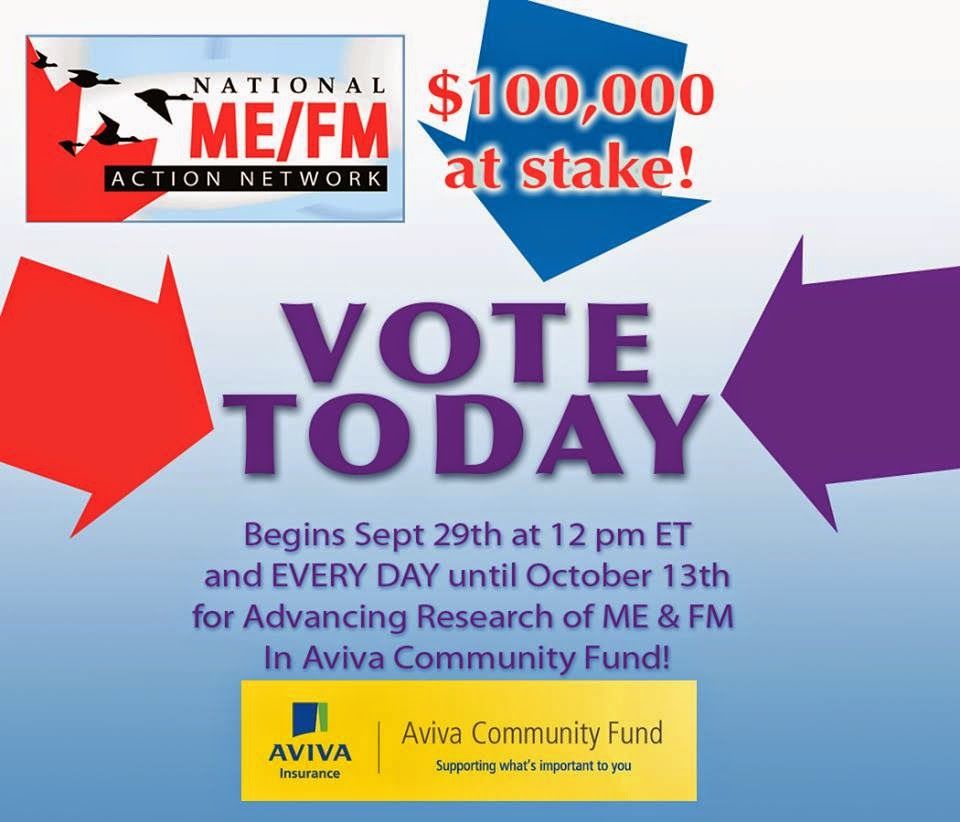
Aviva Community Fund Voting has started!!

The Aviva Community Fund offers up funding each year based on the results of 3 rounds of online voting.

The first round has started and everyone can vote.  Each voter gets a single vote per day - but if you remember to return EVERY day between 29th Sept and 13th October (Canadian times) then you can give all your votes to the same cause.

I would like to encourage everyone to vote for the

"The NATIONAL ME/FM ACTION NETWORK is a Canadian charitable organization dedicated to Myalgic Encephalomyelitis (ME), also known as Chronic Fatigue Syndrome (ME/CFS) and Fibromyalgia (FM) through support, advocacy, education and research."


Their page on the Aviva site is here.  
https://www.avivacommunityfund.org/ideas/acf19712

I have also placed a badge at the top of the side bar on this blog.  It will stay there for the duration of this series of voting rounds.

Badges and Banners for this cause can be found here (scroll down):
https://www.avivacommunityfund.org/ideas/acf19712/digital-action-kit

Hopefully a determined effort by the ME community and all their friends can pull off a massive level of support so that we can win some much needed research funding.


GO FOR IT FRIENDS!!!  

*****************

Other places where you can keep updated about this campaign:


Or if anyone wants a daily email reminder, they can send their email to office@mefmaction.com.

Monday, 29 September 2014

30 Things - Invisible Illness Awareness.

I came across this idea on Invisible Illness and thought it worth ten minutes to complete. Other posts for this are listed on the link, along with instructions on doing your own "30 things". 

30 Things About My Invisible Illness You May Not Know


1. The illness I live with is: Myalgic Encephalomyelitis

2. I was diagnosed with it in the year: 2013

3. But I had symptoms since: 2012

4. The biggest adjustment I’ve had to make is: Doing so much less.

5. Most people assume: I'm just "tired"!

6. The hardest part about mornings are: Not going out.

7. My favorite medical TV show is: Don't have one.

8. A gadget I couldn’t live without is: Computer

9. The hardest part about nights are: Needing to pee....

10. Each day I take _8_ pills & vitamins. (No comments, please)

11. Regarding alternative treatments I: enjoy drinking kefir.

12. If I had to choose between an invisible illness or visible I would choose: Jury's out.

13. Regarding working and career: Had to give up teaching job.

14. People would be surprised to know: I am still "happy"!

15. The hardest thing to accept about my new reality has been: Less spontaneity

16. Something I never thought I could do with my illness that I did was: Dog Agility from a mobility scooter!

17. The commercials about my illness: don't exist

18. Something I really miss doing since I was diagnosed is: Gardening

19. It was really hard to have to give up: Being physically active.

20. A new hobby I have taken up since my diagnosis is: Blogging

21. If I could have one day of feeling normal again I would: Walk along a stormy beach.

22. My illness has taught me: How to enjoy my own company.

23. Want to know a secret? One thing people say that gets under my skin is: "Are you tired?"

24. But I love it when people: talk about normal stuff - and dogs. ;-)

25. My favorite motto, scripture, quote that gets me through tough times is: One day at a time.

26. When someone is diagnosed I’d like to tell them: Rest is important.

27. Something that has surprised me about living with an illness is: We cope.

28. The nicest thing someone did for me when I wasn’t feeling well was: Hubby bought me an all terrain mobility scooter.

29. I’m involved with Invisible Illness Week because: we matter.

30. The fact that you read this list makes me feel: you care.


So there it is. That's a quick round up of stuff about me. Has anyone else done one of these?

Friday, 26 September 2014

Monitoring ME: Fitbit

Working out what I CAN do without illness repercussions is important to me, because  I want to be able to continue to do some of the things I love!

My main tools for measuring my daily activities are a Fitbit and a Heart Rate Monitor. The Fitbit gives me a good idea of how much I've been active, and the Heart Rate Monitor gives me an idea of the intensity of my activities.

My main aim is to avoid PEM (Post Exertional Malaise) because that can lead to long-term losses in my ability.  In this post I'll explain how I use my Fitbit, and in another I'll describe my tactics for using a heart rate monitor.

My Fitbit


I've been using a Fitbit One since November 2012.  It measures my daily steps, my active time, and also gives me an idea of my daily calorie burn. Here's a screen shot from my profile page today.  (There is also a feature for recording sleep but I've stopped using it.)


One of my aims with this, is to always walk slowly enough that the orange "fairly active" line (in the time active graph) stays close to zero.  At first this was incredibly difficult, but over time I've become better at taking things slowly. Obviously the red "very active" line never wavers upwards!

I have also created an Excel spreadsheet into which I enter my daily steps.  & I've set it up to produce some pretty graphs.  :-)

Anyway, I've decided to be brave, and share some of this personal data, in the hope that it will help others to understand.  So this is a scatter graph of  all my daily steps since I began recording almost 2 years ago.


I became ill with ME 8 months prior to the start of this graph, and the most recent dip down was due to a virus at the beginning of the summer.  Other dips, I suspect, were related to my attempts to do things two or three days in a row.

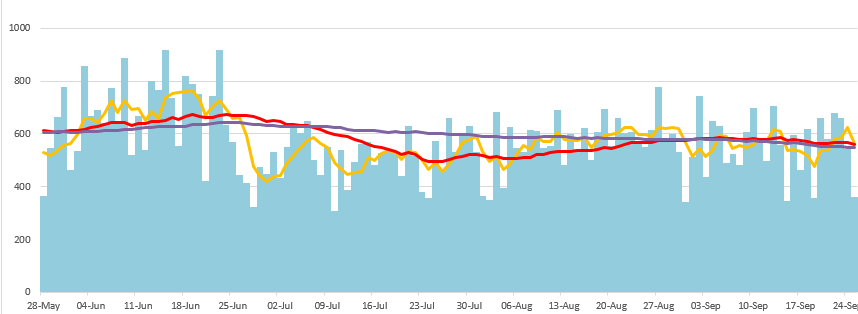
My Excel sheet also does some rolling averages:  I tend to watch my 5 day rolling average (yellow line in chart below) quite carefully.  If I see it creeping up, then I try to take a quieter day or two.  Often it is not the single day up that is a problem, but rather when I do slightly more for several days in a row.

The most dangerous time is when I "feel better" for a few days.  It is also when it is most difficult to pull back!  The drop in this chart however, was that summer virus I mentioned earlier!

Blue columns - daily steps
Yellow line - 5 day rolling average
Red line - 30 day rolling average
Purple line - 100 day rolling average

The red and purple lines, are 30 and 100 day rolling averages, and they give me a clear idea of where my activity level currently lies.  I aim to be consistent from day to day, but it's not easy.  A low step count like this means using a mobility scooter beyond the house, and also restricting what I do inside.

I also try to make a note of other activities that add to my daily exertion levels, such as going out to a coffee shop, or to agility training with my pup.  I write these down beside the raw data (and rolling averages) for each day, with the idea that I can check back for patterns.


I'm not very good at recording subjective data about how I feel.  I did try for a while, but no grading system seemed to work for me.  To be honest, I think that steps are a fairly clear indication of how well I am anyway: I don't do fewer steps without good reason.

Looking forwards: Although that scatter graph above looks depressing, I think it is clear that I have at least managed to halt the early relapses that were probably caused by trying to do too much.  (However, I regard that summer virus, as bad luck not bad management.)

I've no doubt my Fitbit helps me to moderate my daily activities in such a way as to minimise the chances of further relapses.  In this way I believe I am giving myself the best chance of recovery, whilst still managing to do some stuff I enjoy.  However the Fitbit doesn't really help me manage activities "in the moment".  For that I use a heart rat monitor.

Edit to include post on HR monitoring: Starting Heart Rate Monitoring for ME

***************

PS If anyone would like a copy of the Excel spreadsheet that I have created, please let me know and I can email it out for your personal use. I can be contacted at:  keelatoo@ live. co. uk  (omitting the spaces ;) )